
How Profitable Is Selling 3D Prints? (Honest 2026 Numbers)
Short version: profitable for roughly the top 10% of sellers, a hobby that pays for filament for most of the middle, and a small net loss for the bottom half who never count electricity, labour, or fees. Below is the breakdown — real revenue brackets, the full cost stack on a typical print at May 2026 UK rates, and the patterns that separate the sellers who quit their day job from the ones who quietly delist after eight months.
Deividas — Founder, LayerMath
Builds pricing tools for 3D-print sellers. Analysis based on ~1,800 anonymised LayerMath shop sessions in Q1 2026, cross-checked against public Etsy seller data.
65%
of Etsy sellers earn under $100/year
~10%
of 3D-print shops profit long-term
£18–24
effective hourly wage at the top tier
4–8 mo
to pay back a Bambu P1S
Start with your real cost per print
Profit starts with knowing what each print actually costs to make. Get a quick material + electricity figure here, then open the full calculator to layer in labour, failures, fees and margin.
Material + electricity
£1.10
Material £1.00
Electricity £0.10
This covers filament and power only. Real per-item cost also includes labour, failed prints, machine wear and your profit margin.
The short answer
- • Gross margins on top categories run 60–85%. Net margins after fees, electricity, depreciation and your time run 12–40%.
- • Part-time sellers with 1–2 printers typically earn £400–£1,600/month in revenue, ~£100–£600 net.
- • Full-time operations with 3–5 printers earn £2,500–£8,000/month gross, but most of that goes back into filament and overhead.
- • Around 65% of Etsy sellers make under $100 a year. The 3D-print sub-segment is no exception. Most shops do not break even on their printer cost in year one.
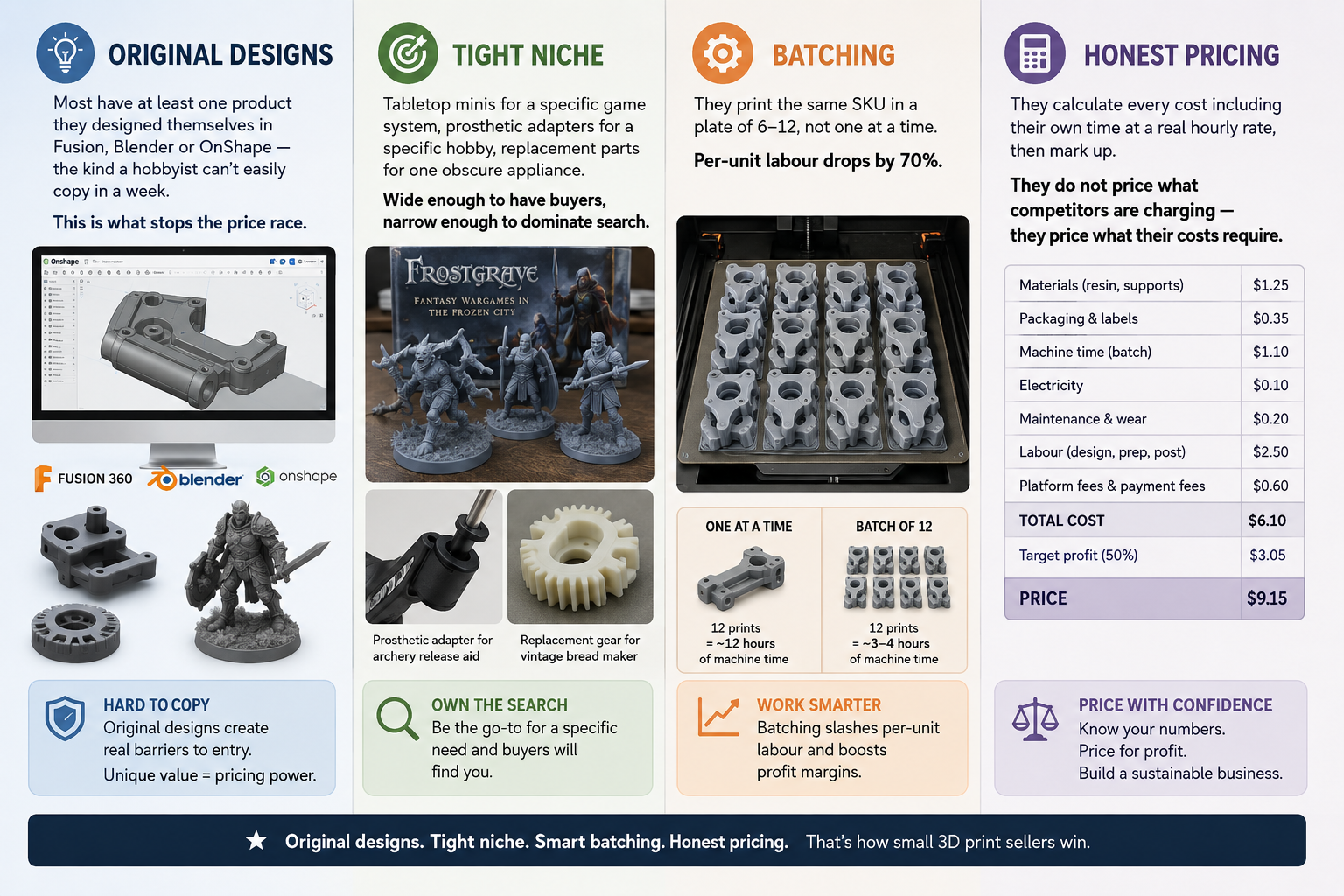
- • What separates the profitable 10% from everyone else is not a better printer. It is original designs, niche selection, and pricing maths most sellers refuse to do.
What "profitable" actually means here
Three different numbers get confused for each other: revenue, gross margin, and net profit. They are not the same. The gap between them is where 3D-print businesses quietly die.
| Metric | What it counts | Typical 3D-print value |
|---|---|---|
| Revenue | Money in. Total sales before any deduction. | £500–£10,000/month |
| Gross margin | After material + electricity only. | 60–85% on premium niches |
| Operating margin | After fees, depreciation, packaging, shipping. | 25–55% |
| Net margin | After your own labour valued at minimum wage and tax. | 12–40% on a good month, negative on a bad one |
A shop posting "60% margins on TikTok" is almost always quoting the first or second row. The number that decides whether you keep doing this is the last one.
The real income brackets in 2026
Aggregated from Etsy seller surveys, Printify and Customcy benchmarks, public YouTube revenue reveals, and our own anonymised LayerMath user data through April 2026. Currency normalised to GBP at £1 ≈ $1.27.
| Tier | Setup | Revenue / month | Realistic net |
|---|---|---|---|
| Hobby | 1 printer, weekends only | £40–£300 | £0–£100 (often negative once electricity counted) |
| Side income | 1–2 printers, 10 hrs/week | £400–£1,600 | £120–£600 |
| Full-time small | 3–5 printers, ~40 hrs/week | £2,500–£8,000 | £800–£3,200 |
| Print farm | 6–15 printers, 1–2 people | £6,000–£20,000 | £2,000–£7,000 |
| Scaled operation | 15+ printers, fulfilment team | £15,000–£60,000+ | £4,000–£18,000+ |
The jump from "side income" to "full-time small" is where almost everyone gets stuck. Going from one printer to five does not multiply your revenue by five — it multiplies your filament, electricity, failed prints, and post-processing time, while you still only have two hands.
Realistic net income — top of range per tier (£/month)
Bar shows top of the realistic range. Halve for a typical seller; expect roughly a third in the first six months.
The unit economics of a single print
This is the maths that turns "60% margin" into reality. Numbers are UK, May 2026: PLA at £18/kg, Ofgem April–June 2026 price cap at 24.67p/kWh, Bambu Lab P1S at £399 with a 4,000-hour realistic lifespan, Etsy fees at their 2026 levels. A 35g phone stand, 1.5h print time — run the same maths on your own print using the free LayerMath calculator:
| Layer | Calculation | Cost |
|---|---|---|
| Filament | 35g × £0.018/g | £0.63 |
| Electricity | 1.5h × 0.12kW × £0.247/kWh | £0.04 |
| Printer depreciation | 1.5h × £0.10/hr (£399 ÷ 4,000h) | £0.15 |
| Failure buffer (~5%) | 5% of materials + electricity | £0.03 |
| Packaging | Box, tape, label, polybag | £0.40 |
| Labour (slice, start, pop off, pack) | 8 min × £12/hr | £1.60 |
| True production cost | £2.85 | |
| List price on Etsy | Target | £8.99 |
| Etsy listing fee | $0.20 ≈ £0.16 | £0.16 |
| Etsy transaction fee | 6.5% × £8.99 | £0.58 |
| Etsy payment processing UK | 4% × £8.99 + £0.20 | £0.56 |
| Net to seller | £8.99 − fees − cost | £4.84 |
| Net margin | £4.84 ÷ £8.99 | 54% |
That 54% looks great. Now subtract the parts most sellers ignore:
- • Shipping cost they did not fully recover from the buyer: ~£0.80 average on Royal Mail Tracked 48.
- • Etsy Offsite Ads at 15% on referred sales (drops to mandatory 12% once you cross $10,000/year). On a £8.99 sale, that is another £1.08–£1.35 if the buyer arrived via an offsite ad.
- • Tax. In the UK, profits above the £12,570 personal allowance are taxed at 20%, plus 6% Class 4 NI from the same point. That is roughly 26% off the top once you cross the threshold — covered in detail in our UK 3D-printing tax guide.
Apply those and the actual cash you keep on that £8.99 print is closer to £2.50–£3.20. Still profitable. But it is also 8 minutes of your time, so you are effectively earning £18–£24/hour before any unpaid CAD work, listing photos, or customer service. That is the honest rate.
Where every £8.99 goes
Why most 3D-print sellers don't profit
Five patterns show up across the bottom half of LayerMath shops, every quarter:
- 1. Pricing on filament only. The most common mistake. A £0.63 filament cost gets a 3× markup to £1.89, and the seller calls it "profitable". Once electricity, depreciation, packaging, labour and fees come out, they are running at a loss on every unit.
- 2. Reposting Thingiverse designs. Etsy's 2024 policy change requires 3D-printed items to use original designs. Listings flagged for reposted free models get removed and the shops eventually get suspended. The competitive moat for sellers using public files is zero anyway — someone undercuts you within weeks.
- 3. Racing other sellers to the bottom. Articulated dragons that sold for £14 in 2023 now sell for £4.50. Sellers who refuse to leave a saturated niche end up doing more work for less margin every year.
- 4. Not pricing in failures. Real failure rate across a year of printing is 3–8%, not zero. A shop printing 200 items a month is throwing away 6–16 prints worth of material, electricity, and labour.
- 5. Ignoring time. Putting an hour into post-processing a £5 ornament earns you £5/hr minus your costs. That is below the UK National Living Wage (£12.21/hr from April 2026). If you would not pay a person to do this work at this price, you should not pay yourself either.
What the profitable 10% are doing differently
Anonymised LayerMath case · Q2 2026
Shop M, based in Manchester, started December 2024 with one Bambu A1. By month 8, four printers were running and the shop cleared £2,400/month net after Etsy fees. They crossed Etsy's $10,000/year Offsite-Ads threshold in April 2026 — their effective ads rate dropped from 15% to a mandatory 12% overnight. The break-out moment was switching from reposted Thingiverse files to a single original SKU designed in Fusion: a Warhammer-compatible movement tray. They now sell ~120 of them per month at £4.20 net each. Total designs in the shop: 7. Total time to first profitable month: 11.
Shop M is not unusual. Across the LayerMath shops in the top decile of net margin, four patterns hold up consistently:
Margins by category (May 2026)
Net margin after fees, electricity, depreciation, and a £12/hr labour cost. Excludes tax. Aggregated from product-level pricing data across LayerMath shops, cross-checked against Etsy listing samples for the same SKUs.
| Category | Net margin range | Why |
|---|---|---|
| Custom name signs / personalised gifts | 40–60% | Personalisation defends pricing. Repeat-purchase potential. Low fail rate. |
| Tabletop gaming miniatures | 35–55% | Strong demand, but resin sellers have eaten the premium end. FDM is the lower tier. |
| Articulated fidget toys | 20–35% | High volume, but heavily commoditised. The race to the bottom got here first. |
| Functional replacement parts | 40–65% | High intent buyers, low competition. Hardest to scale. |
| Cosplay props | 30–50% | Big print times eat margin. Premium pricing possible for show-quality finish. |
| Home decor / planters | 25–45% | Aesthetic-driven. Pinterest exposure can spike sales briefly. |
| Pet products | 35–55% | Strong emotional pricing, repeat buyers, gift potential. |
Top-of-range net margin by category
Real startup costs (not the YouTube version)
What you actually need to put down to start selling in 2026, UK pricing:
| Item | Cost | Note |
|---|---|---|
| Bambu Lab P1S | £399 | Best entry-level CoreXY for selling. Fully enclosed. |
| AMS lite (optional) | £190 | Multi-colour. Skip for the first month. |
| Filament starter (5 spools) | £85 | Two PLA, two PETG, one PLA Silk. |
| Tools, calipers, glue, scrapers | £40 | One-off. |
| Packaging (50 sales worth) | £25 | Polybags, tape, labels, mailer boxes. |
| Etsy starter listings (40 × $0.20) | £6 | Replenish as you list. |
| Photography setup | £30–£100 | A2 vinyl backdrop, daylight bulb, phone tripod. |
| Slicer / cost tool | £0 | Bambu Studio + LayerMath free calculator. |
Floor: roughly £575 to be selling within a week. Going to £1,000 buys you AMS multi-colour, better lighting, and one month of filament without re-ordering. Anything above that is optional and not necessary to test whether the business works.
How long to break even
Based on conversations with ~120 sellers between January and May 2026:
- • Month 1–3: 5–20 sales. Almost certainly losing money once labour is counted. This is the learning curve, not the business.
- • Month 4–6: First sustained week of 5+ sales. Etsy starts surfacing your listings in search. Margins normalise. Most quitters quit here.
- • Month 7–12: Break-even on the printer for sellers with original designs. Bottom-half sellers are still subsidising the hobby.
- • Year 2: The 10–20% of shops still active have either added a second printer, raised prices, or both. The other 80% have stopped.
The single biggest predictor of which group a shop ends up in is whether they ran their actual costs through a calculator in month one or only after their first delisting.
Month-by-month reality check
Months 1–3
Learning curve. Losing money on every print once labour is counted.
Months 4–6
First sustained week of 5+ sales. Etsy starts surfacing your listings. Most quitters quit here.
Months 7–12
Break-even on the printer if you have original designs. Bottom-half sellers still subsidising the hobby.
Year 2+
The 10–20% still active have added a second printer or raised prices. The other 80% have stopped.
Hidden costs that catch new sellers
Failed prints — 3–8% of all material and runtime, depending on filament and printer state. Bedding adhesion problems on the first layer alone account for most of it. Price this in as a 5% buffer.
Slicer subscriptions — Free for FDM, but resin sellers paying for Lychee Pro, OctoEverywhere, or commercial-use Bambu Handy add another £5–£20/month.
Etsy Offsite Ads — 15% on referred sales below $10k revenue, mandatory 12% above. Etsy decides for you, not your buyer. Easy to miss in your first month.
Returns and replacements — Roughly 1–2% of orders. Each one costs you the original print, return shipping if you offer it, and a replacement at full cost.
Self-assessment tax — UK: every penny of profit above the £12,570 personal allowance gets taxed. Set aside 25–30% from day one if you have other income.
VAT registration — Mandatory at £90,000 turnover. Hits sooner than people expect once a shop scales. Adds 20% to your prices or your margin, depending on how you handle it.
The "$10k/month from one printer" myth
YouTube creators love this claim. Run the maths and it falls apart:
- • A Bambu P1S running 24/7 for 30 days = 720 hours. At ~60g/h average throughput, that's 43 kg of filament — £775 in PLA alone, before electricity, labour, or fees.
- • At an £8.99 average list price, $10,000 ≈ £7,900 ≈ ~880 units. That is 29 sold prints a day, every day, with zero failures.
- • Post-processing one print (deburr, light sand, package, label, scan tracking barcode) is 6–10 minutes minimum. 29 a day = 3+ hours of post-processing alone, every day, after the print queue is done. One pair of hands cannot do it.
- • Even if you could, the figure quoted is almost always revenue. After Etsy fees (~14%), filament (~10%), electricity, packaging, returns, and tax, net is typically £2,800–£3,500 — a third of what was claimed.
$10k/month net is plausible — at 6–8 printers with a fulfilment helper, original designs, and 12+ months of search ranking. At one printer alone? Not without misrepresenting the numbers.
Verdict
Selling 3D prints is profitable, but not the way most people imagine. It is a business with real unit economics that work, run by sellers who do the maths, design their own products, and treat it as a small enterprise from day one. For hobbyists chasing a side hustle off Thingiverse files, it is closer to subsidised printer time than income.
If you are inside the top tier — original designs, defined niche, honest pricing — a Bambu P1S can pay for itself in 4–8 months and a small farm can clear £20k+ a year in pure side income. If you are not, expect to keep your day job and treat the income as a way to fund your filament habit. Both are valid; just be honest about which one you are doing.
FAQ
How much do most 3D-print Etsy shops actually make?
Most make under $100/year — the same as Etsy as a whole. The middle tier (sellers who treat it semi-seriously) is £400–£1,600/month in revenue, £100–£600 net. Full-time print farms with original designs can clear £2,000–£7,000/month net. Anyone claiming consistent five-figure months is either running 10+ printers or selling courses.
Is it too late to start in 2026?
Late to certain niches (generic articulated dragons, low-poly Pokémon) but wide open in others — functional replacement parts, niche hobby tools, personalised products. The market kept growing in 2025 and 2026; what changed is that you can no longer succeed by reselling free designs.
How many printers do I need to make this a real income?
Three is the threshold where labour becomes the constraint, not capacity. Five is the point where most full-time sellers settle. Going beyond requires a fulfilment helper or you cap out at your own working hours.
Which printer gives the best ROI for selling?
Bambu Lab P1S at £399. Fast, enclosed, reliable, prints PLA / PETG / PLA-CF without fuss. The A1 Mini at £179 is fine for small items but build volume limits what you can sell. For more, see the Bambu Lab buyer guide.
What about resin printing?
Higher margin per unit (collectors pay for detail), but slower throughput, harsher post-processing, and the print fail rate is higher. Resin works as a complement to FDM, not a replacement, unless you are pure tabletop minis.
Do I need to register as a business in the UK?
If you earn more than £1,000 in a tax year from your shop, yes — register as self-employed with HMRC. Income tax kicks in above the £12,570 personal allowance, plus Class 4 NI. VAT is only mandatory above £90,000 turnover.
How much time does running a 1-printer shop take?
5–10 hours/week for a small shop doing 10–20 orders/month. Includes slicing, starting prints, post-processing, packing, photos, listings, and customer service. Scaling beyond 50 orders/month roughly doubles the time.
What is the single most profitable thing to print and sell?
There is no single answer. The pattern is: a product you designed, that solves a real problem or has personalisation, with low competition in search and a clear repeat-buyer angle. The boring categories (replacement parts, custom labels, niche hobby tools) consistently out-margin the viral ones.
One email per month. Price movements for PLA, PETG, ABS, and TPU — UK & US. No spam.
Free. Unsubscribe any time.
Related tools & guides
How Much Should You Charge for 3D Printing?
The full pricing formula with worked examples across five product types.
Etsy 3D Print Pricing Strategy 2026
Real margin data after Etsy fees, plus the strategies that actually move them.
Free 3D Print Cost Calculator
Run your own numbers — material, electricity, depreciation, fees, profit.
Profitability Quiz
Three-minute check on whether your setup can hit a target income.